Red or Black Bet in American Roulette = 47.37% chance of winning, with a house edge of 5.26%; Placing a side bet on red or black is a good way of maintaining your bankroll and adds an additional element of excitement to the game. While ultimately betting on red or black is a pure game of luck, there are some popular strategies out there. The pockets of the roulette wheel are numbered from 0 to 36. In number ranges from 1 to 10 and 19 to 28, odd numbers are red and even are black. In ranges from 11.
What are the pros and cons of roulette versus the pros and cons of blackjack? How do these games differ, and how are they the same? Like all casino games, they have certain characteristics that hold true for every game you’ll play in a casino. But they also have significant differences, which I’ll analyze for you on this page.
Independent Events versus Deck Composition Strategies
The odds in roulette never change, no matter what happens on previous bets. If you bet on black, the odds are always either 18/38 or 18/37 that you’ll win. That’s because every spin of a roulette wheel is an independent event. Previous results don’t affect the odds on subsequent results.
This doesn’t mean that roulette gamblers understand this. Many of them stubbornly refuse to acknowledge the simple fact that it’s impossible to get an edge on roulette based on studying the results of previous spins. Martingale players take this to a systematic extreme by lowering and raising their wagers based on what happened on the last spin.
Imagine though a new roulette wheel, one in which certain numbers got filled in once they’d been hit. The odds would change with every spin of the wheel, right? For example, there are 18 black numbers, so the odds of winning a bet on black are 18/38. If you removed one of the black numbers after black hit, the odds of winning the same bet would be reduced to 17/38.
It doesn’t take a math genius to understand how you could use this information to your advantage.
But that’s exactly what happens with a blackjack deck. Once a card is dealt, it’s gone, and the composition of the deck has changed. This is how card counters make money. They use a heuristic system to estimate how favorable the deck is to the player.
Some might have trouble getting their head around this idea, but it becomes simpler if you think of it this way. You get paid out 3 to 2 if you hit a natural “21” right? All other bets pay out at even money, so getting a natural blackjack is where a blackjack player makes his money.
But what are your odds of being dealt a blackjack if all four of the aces in the deck have already been dealt? They become 0, right? If the deck has 0 aces in it, and you need an ace and a face or ten to get the 3 to 2 payout, then the house edge increases considerably.
The same holds true for the tens, but there are more of them in a deck. And the reverse of this is true. As the lower cards are dealt, the ratio of tens and aces becomes more favorable. So the card counter raises his bet sizes to take advantage of the higher chance of getting a bigger payout.
Strategy versus Pure Chance
Another aspect of blackjack that’s different from roulette is the ability for the player to affect the house edge by making smart decisions. (The house edge is the percentage of each wager that the casino expects to win over the long run.)

In roulette, the house edge is fixed, regardless of what decisions you make. On an American wheel, you face a house edge of 5.26%. On a European wheel, you face a house edge of 2.70%. No decisions that you make can change this number.
On the other hand, there are multiple decision points in a blackjack hand. You could increase the house edge to 100% by hitting every hand until you bust, for example. (Most players are smarter than that, though.)
Smart blackjack players use something called “basic strategy” to make their decisions. Basic strategy provides the mathematically best play in every situation that might come up. It’s generally easy to memorize.
The difference between using basic strategy and just playing your hunches is significant. Game conditions vary, but generally speaking, if you use correct basic strategy, you can reduce the house edge to between 0.5% and 1%. Players who don’t know basic strategy face a house edge of 4% to 5%.
If you like making decisions that affect your outcome, and you want to play a game where you can get edge by an advantage maneuver like counting cards, skip the roulette table. Play blackjack instead.
On the other hand, if that sounds like too much trouble, roulette can be a lot of fun. It’s not a sucker bet, no matter what anyone tells you–unless you buy into some loony roulette system or superstition.
Wagers per Hour
Another difference that has a practical effect on a player is how many wagers per hour happen at the table in the two games. You can estimate how much money you’ll expect to lose per hour if you multiply the size of your wager by the house edge and multiplying that by the number of wagers you make per hour.
Roulette is a relatively leisurely game. If you’re playing at a table with five other players, you’re only going to be seeing 35 spins per hour. If you only place a single wager per spin, you can easily estimate your average hourly loss.
Suppose you’re betting $5 a spin. The house edge is 5.26%. So you can expect to lose about 26.3 cents per spin. You can expect to lose a little over $9 per hour at that rate.
Of course, with fewer players at the roulette table, you can expect to see more wagers per hour. If it’s just you and the dealer, for example, you can expect to see 100 or so spins per hour, which will triple your expected hourly loss.
Blackjack is a faster-paced game. If you’re playing blackjack at a table with 5 other players, you can expect to see 60 hands per hour. If you’re playing with perfect basic strategy (1% house edge) at $5 per hand, you can expect to lose a nickel per hand. That’s just $3 per hour. Even though you’re putting almost twice the money into action per hour, your entertainment is costing you even less.
Does that make blackjack better than roulette? That depends on your personality. Do you like a leisurely, elegant game? Do you prefer not to have to think too much when gambling? Then roulette is better than roulette—for you.
On the other hand, if you like card games and enjoy the challenge of making correct decisions, blackjack is more likely to be suited to your personality.

The pros and cons of each game are all based on what you prefer as a gambler.
Around 20 years ago, when I had no idea about winning roulette, I approached a roulette table with around 10 reds in a row. I thought to myself that black is due to spin next. After all, what are the chances of red winning again, right? Well I lost. Then I said to myself I’d have to be very unlucky to lose again. So I increased my bet, and lost again. This happened for the next few spins, until I eventually blew my entire bankroll. I lost everything that I so proudly won earlier with my dozens betting system. Only many years later did I understand my delusion.
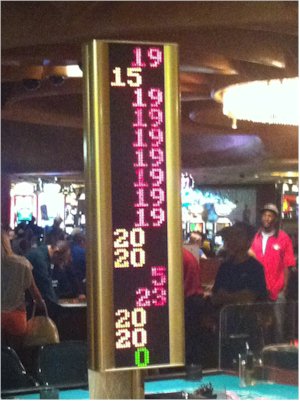
The image shown here looks crazy I know. It was originally published by a player who seemed to want to discredit the casino. But the truth is the casino staff were adjusting the wheel and attached equipment, which gave the strange readings. It is still possible such a sequence will spin, but I’ll explain more about it later.
The odds of red or black spinning in a row
On the European wheel, there are 37 numbers. 18 are black, and 18 are red. So the odds of red spinning are 18/37 = 0.4865. The odds of black spinning are the same. And it’s the same for any “even chance” bet including highs and lows, and odds and evens. The odds do not change no matter how many reds or blacks have spun in a row. Consider again my loss when I bet on black. What I failed to realize is the odds of black or red spinning next are not affected by previous sequences. There is an exception that i wont explain in this article, but the statement is true in the cases of almost every losing roulette system.
Take my situation for example. Some players at the table thought red was on a winning streak, and that it would continue. I saw it differently and expected the streak to end. Who was right? Actually none of us were right. I just happened to get unlucky.
If you want to get technical, the odds of red then black spinning are 1 in (0.4865 x 0.4865). But it’s the same as red then red spinning, or black then black.
The odds of dozens spinning in a row
There are three dozens on the table, and 37 numbers. So the odds of a dozen spinning once is 12/37. Again the odds don’t change based on previous dozens. They will always be the same. If you’re new to roulette, it may be hard to get your head around the concept. But keep in mind thinking that streaks will continue or end is one of the most common misconceptions about gambling. It is a concept that is old as history itself. Billions of gamblers have applied the principles and lost. It might be wise to consider what so many people have learned.
The mistakes you don’t know you’re making
If you need convincing of the above, I suggest run hundreds of thousands of trials with automated software. Or even use a simple excel chart. Count the number of times red and red spin, then check the odds that red or black will spin next. the result is the odds are still the same, for both red and black. Actually I created free software to demonstrate this principle. The interface is shown below.
Get the software from http://www.roulettephysics.com/roulette-pattern-detector/
Basically you load as many spins as you want into a text file, then ask the software to find a sequence of numbers like 0,0,0. This will check how many times 0 spun three times in a row. Then check how many times the numbers 23,4,15 spin in this exact sequence. If you test enough numbers (millions or more is advised), you’ll find the odds are still the same. So the odds of 0,0,0 are the same as 1,2,3 or 3,2,1 or 14,12,34 and so on. So next time you see three zeros in a row, don’t be so surprised. Because really it’s the same as any other three numbers. It’s merely more recognizable to you. After all, three zeros seems pretty obvious on the marquee (where winning numbers are displayed).
Maybe you now understand this. But here’s the part you may not understand yet . . .
Most roulette systems use a betting progression. For example, after 3 reds in a row, you bet on black. But this is fundamentally the same as after red,black and red, you bet black. There is no difference. To take it a step further, now consider adding betting progression where you increase bet size after losses. You may think you’re increasing your chance of winning, but all you’re actually doing is changing the amount you risk. Here’s proof:
If you saw red, red and red spin in a row, you may bet $100 on black and lose. For now forgetting the existence of green zero, the odds of you losing that $100 is 50%. Next you double your bet to $200 and hope to win back your $100 and win an extra $200. But the reality is you have just made two completely independent bets as per below:
Bet 1: $100 on red (50% chance of winning)
Bet 2: $200 on red (50% chance of winning)
The math is very simple. Nothing has changed except the amount you have bet. You can either get lucky and win back your losses, or lose big. Will the casino owner be upset if you get lucky and win? No because they know for every winner, there’s a loser. And in the bigger picture, there are more losers than winners. In fact casinos actually need people to win sometimes, to keep hope alive.
Wizard Of Odds Roulette Free
Conclusion
Roulette Red Or Black Odds
To win roulette consistently, you need to see past the illusion of sequences and patterns. Patterns like 1,2,3 spinning make sense to us, but really it’s no different to 32,4,10 spinning. And betting progression wont change anything except the amount you win. The only way to beat roulette is by changing the odds of you winning, and this is not done by looking for repeating numbers, or numbers that haven’t spun in a while. It is done by understanding why the ball lands where it does, and using this knowledge to properly assess a wheel and predict spin outcomes.